Today we did the process of Critical Friends model concerning our PBL driving questions. I wanted to write about this experience as I found it to be a professionally informative experience.
After our team shared our PBL driving question we discussed how we were attempting to do this and our approach. It was good to have another conversation about our PBL and clarifying a few things.
The feedback and discussion by the other group about our PBL was very professional, positive and most importantly helpful. It made us think and clarify things for us and ensure we have a deep understanding of what we are doing by the other group asking provocative questions and giving feedback. Sometimes it is good to be challenged a little on what you are doing and if done in a constructive and respectful way it can help with your thinking. I felt the feedback was not done in a negative way and was professional. It was done in a supportive way and with the help of senior management it meant it stayed on track.
Another really good thing about sharing our PBL driving questions is we learnt about what others are doing in the school. This time around we got to hear what the Year 7/8 classes were doing which was interesting to see how we are doing similar things but at different levels. It also helped us to discover that the year7/8 children could help us in our PBL. It is nice to know what others in the school are doing and the fact that we are all heading to a very similar end.
This Critical Friends model process helps to form good collaborative relationships with all colleagues including across teams. I feel this process strengthens relationships and helps us to develop as teachers.
Overall I was pleased we did this process and hope that we continue to do this process for future PBL topics.
There are a number of articles on this approach- Critical Friends
Tuesday, 24 July 2018

Why Teach Problem Solving?
I thought this was a good article to start with as it helps for me to gain more of understanding into why I should go on to teaching problem solving. If I am going to make this a part of my daily programme I need to be strong in my understanding as to why I am going to do it.
This article mentions the theory of learning called Constructivism which is when we construct our knowledge through our experiences rather than absorbing what we are told. The opposing side of this is that the child is an empty vessel and needs to be filled. The author of this article says that we need to be looking at both approaches. It appealed to me as I believe that is true as yes a child can be an active learner but however they still need some knowledge. This reinforces the idea that we need to have problem solving as well as the curriculum side as well. I have had discussions with friends who's school has tried to do problem solving as their main approach to maths and this has had varying results.
Some of benefits of problem solving according to this article are
- development on their current knowledge
- interesting and enjoyable way to learn mathematics
- teaches thinking, flexibility and creativity
- encourages cooperative skills
- based on current knowledge
- similar in approach to the way that other subjects are taught in primary schools
That last point was an interesting view point that I had not considered. I can see how PBL can be similar to problem solving as there is a question and you are trying to find the answer. The skills of creativity, flexible, creativity and cooperative skills are very much skills we are trying to teach children and so this is a huge benefit to the children for them to be doing it in problem solving as it is what we are trying to get the children to do.
I liked this article as it went over the difficulties of teaching problem solving. The difficulties being
- It produces teacher discomfort
- It produces student insecurity
- It puts constraints on the curriculum and takes too long to teach
- It is not possible with students of low ability
- It takes a lot of preparation
I think that the article covered nicely how to compact this, however the low ability other than getting someone to read for them and going through a few at the start as a whole class activity in my opinion there was no great advice in this area.
Overall it was encouraging to read this article to reinforce my idea that is will be good to include more problem solving in my programme. My question is how to do this effectively and I am keen for the children to improve on their math talk.
Sunday, 29 April 2018
Energise Conference 2018
I was lucky enough to go to this conference in Rolleston and had the privilege of listening and actively learning some new things.
I learnt more about robots and how to include these into the classroom programme. I liked how West Rolleston has sorted a progression for the computer science area. It states which robots they would use at which level. Although the children can use robots at lower levels if appropriate. I talked to Megan afterwards and she explained that the juniors tended to integrate where possible the robot work and the year 5-8 did computer science once a week for an hour. This was good to hear as I would love to do work with robots but just need to think how can it practically put in the classroom programme. I really enjoyed having a go with the robots and look forward to doing more of this in the future.

Sketchnoting- Sylvia Duckworth-a name I knew and was pleased to meet this lady. Sketchnoting is an interesting approach to taking notes. I am definitely a person who tries to take notes in a creative way and if you look at my notes you will often see me trying to be creative. I enjoyed learning about this and was lucky enough to hear from a few other teachers how they incorporate this into their programme. In my current class I have a couple children who would probably benefit from learning how to do this and would like to teach it to all the children as it is interesting way to take notes. I would love to get her book to get more ideas on how to do this and you definitely need practise this skill. Sylvia's final speech she talked about Why creativity Matters. The three truths she talked about with creativity is, it is good for mental health, has cooperative benefits and can be learnt. Creativity allows people to express themselves in different ways and can allow us to go further with our ideas. Being creative is a skill that we need and so what I need to ensure is I allow plenty of opportunities for children to be creative.

Monday, 9 April 2018
Keeping Children Engaged and Achieving in Mathematics
I recently read some reports on teaching strategies and approaches that were observed in schools across New Zealand. This report shares some of the simple strategies used in classrooms where achievement in mathematics had been accelerated.
Some key things came out of the different studies I read

Some key things came out of the different studies I read
- Mixed ability groups-what the studies said in this area is that there are several positives to this approach. Benefit for more able mathematicians was that they think more deeply about alternative solutions. It helped with children who were not positive about maths by changing their thinking as they gained more confidence since working in mixed ability groups. These children were also able to experience a wider variety of mathematical strategies.
- Maths Talk- A good thing that I can see from this approach is that they speak more maths talk. It is important that they are taught how to do this and how to approach the maths problem. If children share their approaches to a problem it will help them have a deeper understanding of what they have learnt. Children were noted to say that they liked being taught strategies by their peers because they found it easier to understand their language.
- Support- There is a need for some Professional Development in this problem solving approach to ensure all teachers are on the same page in going forward. Parents/caregivers need to be aware of this different approach for maths and how it can benefit their child and also how they can help at home to support their child.
I plan to get started on including more problem solving in my maths programme and reading this does certainly show some positives for starting this type of approach. I of course still admittedly have a few concerns about mixed ability but do like the idea of doing problem solving that is authentic and will give definitely give a go. I wish to get some resources in the area of teaching the children how to approach problem solving questions. I have found in what I have done so far they need some work in this area.

Sunday, 25 February 2018
Maths-New Way of Thinking
Well the start of another year and some exciting things to consider. Currently as a team we are looking at how we do things in the area of maths. This has lead to some interesting thinking that I have had in the back of my mind for around a year or so since I heard about different approaches. It is good to change things up and after looking at some statistics there is hard evidence to suggest another approach could be good.
I have enjoyed teaching problem solving, as I have mentioned before, when I was younger this was a real struggle for me as a young child and I don't wish to make this the case for other children. We are looking at how we could incorporate this into a daily maths programme effectively. The other part we plan to do as a team is to include workshops into the programme as well.
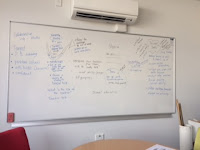
So after a good discussion on this as you can see from the whiteboard, we discussed some good questions and things to ponder on.
Some of the questions I have are
How do we ensure all children benefit from this approach?
How do I ensure that the children are supported in this new approach?
What resources are available to ensure the children get suitable problem solving activities?
What will workshops look like?
I liked how we discussed having some baseline data as this will be an interesting to compare with later on. Although the case study I read mentioned it is possible there will be small dip but getting information from our year 3 children and teaching them again next year may help give us some interesting results.
Here are a few things I am looking forward to seeing
- more maths talk
-children using maths in more practical problem solving ways
- hopefully more children speaking about maths and sharing their ideas
-more discussion about maths in everyday situations
I plan to read more case studies and generally find more information on doing workshops on the problem solving approach.
I have enjoyed teaching problem solving, as I have mentioned before, when I was younger this was a real struggle for me as a young child and I don't wish to make this the case for other children. We are looking at how we could incorporate this into a daily maths programme effectively. The other part we plan to do as a team is to include workshops into the programme as well.

So after a good discussion on this as you can see from the whiteboard, we discussed some good questions and things to ponder on.
Some of the questions I have are
How do we ensure all children benefit from this approach?
How do I ensure that the children are supported in this new approach?
What resources are available to ensure the children get suitable problem solving activities?
What will workshops look like?
I liked how we discussed having some baseline data as this will be an interesting to compare with later on. Although the case study I read mentioned it is possible there will be small dip but getting information from our year 3 children and teaching them again next year may help give us some interesting results.
Here are a few things I am looking forward to seeing
- more maths talk
-children using maths in more practical problem solving ways
- hopefully more children speaking about maths and sharing their ideas
-more discussion about maths in everyday situations
I plan to read more case studies and generally find more information on doing workshops on the problem solving approach.
MATHS IS EVERYWHERE!
Thursday, 23 November 2017
PBL
I have now completed my first year of teaching PBL and thought I would share some of my thoughts. As mentioned earlier the latest PD session helped heaps with the planning of PBL projects. I have enjoyed teaching the projects this year as they are varied and interesting for the children. The children have been engaged more than I have experienced in previous type topic work.
The one thing I was worried about with this approach to learning was how the children would cope with more independence in the way they learn. I have found it not too bad as we kind of scaffold it a bit at the start of the year for the children. We did have to teach them some self managing skills at the start, however this improved as the year went on. So overall I have been pleased with the children's improvement in self regulation and independence. The children have done a lot of work in teams which has had its ups and downs. However the children have wised up to who they choose to work with and have learnt new skills on how to work collaboratively with children who they may not normally work with.
I know at the start of next year we plan to get the children to do more work on working in teams at which should set them up good for the year.

PBL- Project Based Learning
I have recently had the pleasure of experiencing a PD session with Thom Markham from America on PBL. This is an approach that this year I have been attempting to do, which has been a challenge but I am liking this approach so far.
I liked many of what this man had to say especially about the way education is changing and in my view needs to happen. He did bring up an interesting point and that is children can access many things on their phone so how important is content when we can look that up? I was listening to a podcast where Ted Dintersmith spoke about how we are training children up for different jobs from 20 years ago and we need to consider this when teaching. This did make me think how content is important but I agree strongly that certain skills are essential in the 21st century and maybe we need to look at this more. The three C's are mentioned Creativity, Collaboration and Critical thinking which are definitely skills the children need. The PBL approach helps to gain these important skills.
The driving questions is very important to gain the best out of the PBL experience. Although the process can be challenging to come up with a driving question it is worth it to get a good one. When I looked around it was great to see all of the teachers working at the PD session in what I would call a very collaborative approach to working out these driving question. The guidance from Thom during this process was invaluable as he guided us well to come up with driving questions easily due to his vast experience.
I feel more confident after the PD sessions to come up with a driving question and what this looks like.
Subscribe to:
Posts (Atom)